
You’ve probably been there. You decide to make a change in your business—maybe a new way of doing things, a different approach to customers, or a shift in how your team works. You announce it, everyone nods, and then… nothing really changes. Or it changes for a week and then slowly drifts back to the old way.
Frustrating, right?
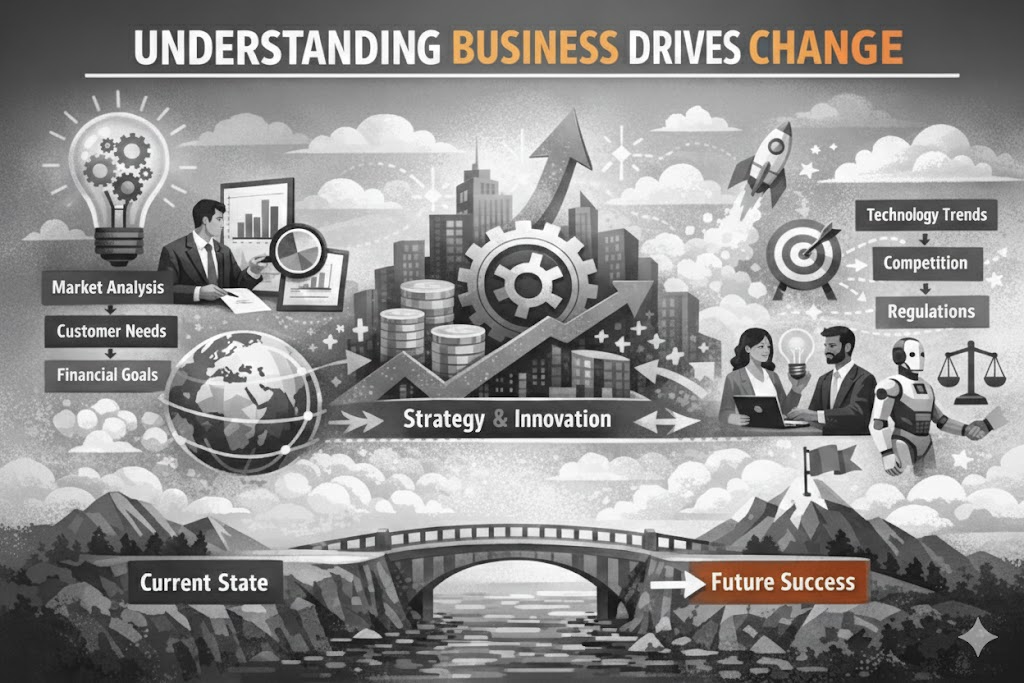
Here’s the thing: change in a business doesn’t happen just because you want it to. There are actual drivers—things that push and pull change through your organization. Understanding these drivers can be the difference between a change that sticks and one that fizzles out.
Two smart guys named Burke and Litwin spent years studying how organizations change, and they came up with a model that maps out all the different things that drive change. Now, they created this for big corporations, but the principles work just as well (maybe even better) for small businesses.
Let me break it down in plain language.
The Big Picture: Two Types of Change
First, you need to understand that not all changes are the same. Burke and Litwin identified two main types:

Transformational Change – This is the big stuff. Changes that fundamentally shift what your business is or how it operates. Think: changing your entire business model, entering a completely new market, or totally reinventing your company culture.
Transactional Change – This is the day-to-day stuff. Tweaks and adjustments that make things run better but don’t change the core of what you do. Think: updating a process, changing a policy, or reorganizing team responsibilities.
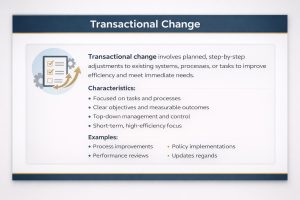
Both matter. But they work differently and need different approaches.
The Transformational Drivers (The Big Movers)
These are the heavy hitters—the things that create major change in your business. When these shift, everything else has to follow.
1. External Environment (What’s Happening Out There)
This is everything outside your business that affects you: the economy, your competitors, technology changes, new regulations, customer trends, even stuff like pandemics or political changes.
For small businesses: You can’t control this, but you have to respond to it. When COVID hit, restaurants had to pivot to delivery. When e-commerce exploded, brick-and-mortar shops had to get online. When your biggest competitor drops their prices, you have to react.
The point: External pressure is often what forces you to change. Don’t ignore what’s happening in the world around you.
2. Mission and Strategy (Why You Exist and Where You’re Going)
Your mission is your “why”—why does your business exist? Your strategy is your “how”—how are you going to win?
For small businesses: This is your North Star. When you change your mission or strategy, everything else needs to align with it. If you decide to shift from being the “cheapest option” to being the “premium quality option,” that’s a strategic change that will ripple through everything—your pricing, your marketing, who you hire, how you train them, everything.
The point: Clear mission and strategy give purpose to all your other changes. Without them, you’re just making random adjustments.
3. Leadership (You and Your Core Team)
This is about the people at the top—their vision, their behaviour, their decisions. In a small business, this is probably you and maybe a couple of key people.
For small businesses: You ARE the change. If you want different results but you keep doing the same things, nothing will change. Your team watches what you do more than what you say. If you say “customer service is our priority” but you never follow up with customers yourself, your team won’t either.
The point: Change starts with leadership. You have to model what you want to see.
4. Organizational Culture (How We Do Things Around Here)
Culture is the unwritten rules, the shared beliefs, the “way we do things.” It’s what happens when you’re not in the room.
For small businesses: Your culture might be informal, but it’s powerful. Is your culture “we work until the job is done” or “we respect work-life balance”? Is it “the customer is always right” or “we stand up for our team”? Is it “try new things and learn from mistakes” or “stick to what works”?
The point: If your desired change goes against your culture, it won’t stick. You need to either change the culture first or design the change to fit the culture.
The Transactional Drivers (The Day-to-Day Stuff)
These are the operational pieces that keep things running. When you change these, you get improvements, but not fundamental transformation.
5. Structure (How You’re Organized)
This is your org chart, your reporting lines, how teams are set up, who does what.
For small businesses: In small businesses, structure is often fluid. Maybe one person wears five hats. That’s okay, but there still needs to be clarity about roles and responsibilities. When things go wrong, does everyone know who’s accountable?
The point: Good structure supports your strategy. Bad structure creates confusion and
bottlenecks.
6. Systems (Your Processes and Procedures)
These are your standard ways of doing things—how you onboard customers, how you handle
inventory, how you manage finances, how you communicate.
For small businesses: This is what we talked about in the systems blog! When your systems align with your goals, work flows smoothly. When they don’t, you get chaos. The point: Systems should make life easier, not harder. If a system isn’t supporting your goals, change it.
7. Management Practices (How Managers Actually Manage)
This is about how your managers (or you, if you’re managing people) actually manage day-to-day:
How do they give feedback? How do they make decisions? How do they handle problems? How do they support their team?
For small businesses: Even if you don’t have “managers,” you still have management practices.
How do you check in with your team? How do you handle mistakes? How do you celebrate wins?
How do you deal with conflict?
The point: Good management practices build trust and capability. Bad ones create fear and dysfunction.
8. Work Unit Climate (The Vibe in Your Team)
This is the feeling and atmosphere in the day-to-day work environment. Do people feel safe to speak up? Is there trust? Is it supportive or competitive? Stressful or calm?
For small businesses: You can feel this when you walk in the door. Is your team energized or drained? Collaborative or siloed? Innovative or just going through the motions?
The point: Climate affects performance. A toxic climate kills productivity and drives good people away. A healthy climate makes people want to come to work.
The Individual Level (Your People)
At the end of the day, organizations don’t change—people do. Burke and Litwin identified three things at the individual level that matter:
9. Task Requirements and Individual Skills (Can They Actually Do It?)
This is about whether your people have the skills and knowledge to do what you’re asking them to do.
For small businesses: If you want to change how something is done, do your people actually know how to do it the new way? If you want to start using new software, has anyone been trained?
If you want better customer service, does your team know what good looks like?
The point: You can’t expect people to do things they don’t know how to do. Training and support matter.
10. Individual Needs and Values (What Motivates Them?)
People have their own needs, goals, and values. Some want growth and challenge. Some want stability and security. Some are motivated by money, others by purpose or recognition.
For small businesses: You probably know your team pretty well. What makes them tick? Are you asking them to change in ways that align with what they care about, or are you asking them to go against their nature?
The point: When changes align with what people value, they embrace them. When they don’t, you get resistance.
11. Motivation (Do They Want To?)
This is the energy and drive to actually do the work. It’s one thing to know how to do something (skills) and another to actually want to do it (motivation).
For small businesses: If your team is going through the motions without energy or enthusiasm, something’s off. Maybe they don’t see the point. Maybe they’re burned out. Maybe they don’t believe it will matter.
The point: Motivation comes from seeing purpose, feeling valued, and believing your effort will lead to something good.
12. Individual and Organizational Performance (The Results)
This is the output—the actual results you get from all of the above. Are people performing well? Is the organization hitting its goals?
For small businesses: This is your bottom line, your customer satisfaction, your team retention, your growth. When everything else is aligned, performance follows. When it’s not, performance suffers.
The point: Performance is the outcome of everything else working together. If performance is poor, look upstream at what’s not aligned.
How It All Connects
Here’s where it gets interesting: everything is connected. Change one thing, and it affects the
others.
For example:
- External pressure (like a new competitor) forces you to change your strategy
- Your new strategy requires changes to your structure and systems
- Those system changes require new skills from your team
- Your leadership needs to model the new approach
- This gradually shifts the culture and climate
- When people are motivated and have the right skills, performance improves
It’s a cycle. And it works in both directions—top-down and bottom-up.
Making This Work in Your Small Business
So how do you actually use this? Here’s the practical approach:
When You Want to Make a Change:
Step 1: Identify what kind of change it is Is this a big transformational change (changing strategy, entering new markets) or a transactional change (improving a process, updating a policy)? This tells you how much of the organization will be affected.
Step 2: Start with the right driver
- If it’s about responding to market changes → Start with External Environment and Strategy
- If it’s about improving operations → Start with Systems and Management Practices
If it’s about people not performing → Start with Skills, Motivation, and Climate
Step 3: Map the ripple effects Ask yourself: If I change THIS, what else needs to change? Don’t just think about the direct change—think about how it will affect structure, systems, people, and culture.
Step 4: Get leadership aligned If you’re the leader, get clear on what you need to model. If you
have other leaders, make sure everyone is on the same page about the change and their role in it.
Step 5: Address the people side
- Do they have the skills?
- Do they understand why this matters?
- Does it align with what they value?
- What will motivate them to embrace it?
Step 6: Watch the climate and culture Pay attention to how people are feeling and reacting. Is the change creating a positive vibe or is it causing stress and resistance? Adjust as needed.
When Change Isn’t Working:
If you’ve tried to make a change and it’s not sticking, use this model to diagnose what’s wrong:
- Is the external environment pulling in a different direction?
- Is your strategy unclear or conflicting?
- Are leaders modelling different behaviour than what you want?
- Is the culture resisting the change?
- Is the structure making the change hard to implement?
- Are the systems set up to support the old way?
- Are managers undermining it with their daily practices?
- Is the climate making people afraid to try?
- Do people lack the skills to do it differently?
- Does it conflict with people’s values?
- Is there no motivation because people don’t see the point?
Usually, when change fails, it’s because one or more of these pieces is out of alignment.
A Real Example
Let’s say you want to improve customer service in your small retail business.
The wrong way: Just tell your team “be nicer to customers” and hope it happens.
The Burke & Litwin way:
- External Environment: Customers now expect the kind of service they get from Amazon—fast, easy, personalized. You’re losing business to competitors who deliver this.
- Strategy: You decide to become known as “the place where people actually care about you.”
- Leadership: You start modelling it—greeting every customer warmly, remembering their names, following up after purchases.
- Culture: You talk about great customer experiences in every meeting. You celebrate
examples of amazing service. You make it clear that rushing a customer to make a sale is not okay. - Structure: You make someone responsible for customer experience, even if it’s part-time.
- Systems: You implement a simple CRM to track customer preferences. You create a follow-up system for purchases. You develop a process for handling complaints that empowers employees.
- Management Practices: You coach your team on customer interactions. You give positive feedback when you see great service. You address it when someone is rude.
- Climate: You create an environment where it’s safe to spend time with customers, where going above and beyond is celebrated, where people aren’t stressed about rushing.
- Skills: You train your team on how to have conversations with customers, how to read
needs, how to handle difficult situations. - Values & Motivation: You hire people who genuinely like helping others. You make customer compliments visible to the team. You show how better service leads to better tips or bonuses.
- Performance: Sales go up. Customer complaints go down. People leave positive
reviews. Your team feels proud of their work.
See how it all connects? You didn’t just “ask for better service”—you aligned multiple drivers to support that change.
The Bottom Line
Change is hard. But it’s a lot less hard when you understand what actually drives it.
You don’t need to create complicated charts or analyze every detail. But you do need to think beyond just announcing a change and hoping people will follow.
Ask yourself: “What external forces are pushing for this change?”
- Is my strategy clear?
- Am I modelling what I want to see?
- Will my culture support this or fight it?
- Do my systems and structure make this possible?
- Are my managers reinforcing it?
- Do people have the skills and motivation to do it?
When you line up these drivers, change becomes a lot more natural. When they’re out of whack, even small changes become exhausting battles.
The good news? In a small business, you have way more control over these drivers than big companies do. You can shift culture faster. You can change systems more easily. You can model new behaviour and have people see it immediately.
Use that advantage. Understand what drives change, align the pieces, and watch things actually start to move. You can always get in touch with us to learn more.